The Weaponisation of Motherhood: How Society Uses Your Love Against You
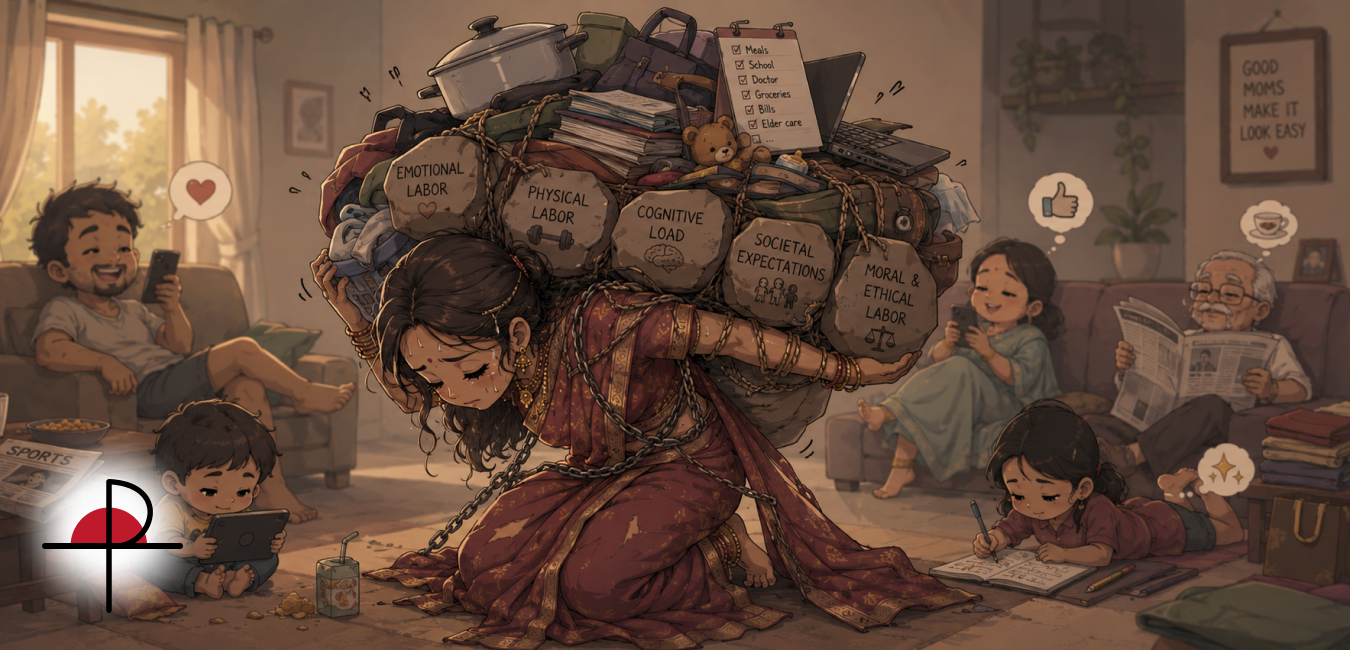
You didn’t lose your mind. You lost the right to be a person.
There is a particular kind of exhaustion that no diagnostic manual names: the exhaustion of a woman who has been told, in a thousand different ways, that her suffering is proof of her inadequacy as a mother. This piece is for her.
The “Good Mother” Archetype Is a Trap
A landmark qualitative study published in Frontiers in Global Women’s Health (2026) examining urban Indian mothers found that the “good mother” archetype is built on one foundational demand: total self-erasure. A woman must completely subordinate her own needs, desires, and distress to the family unit. Full stop.
This is not care. It is control with a tender name.
When a woman begins to crack — when she expresses dissatisfaction in her marriage, hints at burnout, or considers leaving — the archetype is weaponised against her through three precise mechanisms.
1. The Guilt Machine
The narrative is simple and devastating: any fracture in the home is the mother’s fault. Children struggling academically? The mother failed. Children anxious? The mother was too anxious herself. Marital toxicity created by two adults? Society asks only what the mother did wrong.
Adrienne Rich, in her seminal Of Woman Born (1976), argued that institutionalised motherhood reduces women to instinct-driven caregivers, stripping them of individual personhood and replacing it with perpetual, unresolvable anxiety over whether they are “enough.” Five decades later, that anxiety is still being industrially manufactured and used as leverage.
2. Pathologising Protest
Maternal anger is not a disorder. It is a diagnosis of the household.
When mothers experience rage, resentment, or profound exhaustion in response to an unequal division of labour or emotional abandonment, those responses are routinely medicalised — labelled “postpartum rage,” “anxiety disorder,” or the evergreen catchall, “hormones.” The Frontiers in Global Women’s Health (2026) study makes this argument explicitly: maternal anger should be understood as a protest, an embodied critique of gendered systemic inequity, not a pathology requiring medication or dismissal.
When your partner calls you “hysterical” for pointing out that you haven’t slept properly in eight months, that is not a description of your mental state. That is a silencing strategy.
3. The Maternal Wall: A Structural Trap
The weaponisation is not only interpersonal. It is architectural.
Research on “maternal wall bias” documents a double-bind that operates with mechanical precision (Bateson, 2023): if a mother builds financial independence — the very resource she needs to leave a toxic marriage — she is penalised as “cold” or “uncommitted.” If she stays home, she suffers the documented wage penalty that erodes the economic autonomy required to protect herself and her children. The trap is structural, not accidental.
The Village That Watches Instead of Helps
We were told it takes a village to raise a child. Nobody mentioned that the modern village has abandoned its scaffolding function and taken up surveillance instead.
For women who are visibly capable — independent, articulate, professionally accomplished — the village does not offer support. It offers an audience for failure. Society frames a strong woman’s motherhood as hubris to be corrected. Extended family and community do not step in to hold her up; they step back to audit her choices.
She is told to trust her maternal instincts, and the moment she does, those instincts are second-guessed, micro-managed, and overridden. The result is a state of perpetual low-grade warfare over her own parenting.
The Labour That Predates Birth
The sheer volume of unacknowledged labour begins before the baby arrives.
The nesting instinct — the hyper-vigilant preparation of a safe, functional home — is an evolutionary drive rooted in infant survival. In the modern household, it is regularly dismissed as a “cleaning frenzy” or obsessive behaviour. The physical reality of labour, postpartum recovery, and nursing is compound interest on a body that is already bankrupt.
When women name this exhaustion, that biological fact is turned into evidence of their emotional instability.
This is textbook gaslighting: taking a valid, embodied protest and reframing it as a personal defect.
Death by a Thousand “Helps”
Perhaps the most corrosive damage is the quietest: the micro-aggressions embedded in daily domestic life.
The foundational problem is a framing issue. When a father views any engagement with his child as “helping” the mother, he has defined the child as her personal project and himself as a generous volunteer. This single cognitive distortion produces an entire ecosystem of micro-invalidations:
The Resentful Wake-Up: The heavy sighs and eye-rolls when asked to take the 3:00 AM shift so the mother can sleep two consecutive hours.
The Quality Audit: “Checking” the bathwater temperature while she is bathing the child — a small act that communicates she cannot be trusted with her own baby.
The Casual Commentary: Noting that the baby didn’t eat well the one evening he was in charge, while erasing the hundreds of meals she managed alone.
Individually, these seem trivial. Cumulatively, they constitute a sustained erosion of maternal confidence and self-trust. Research on relationship micro-aggressions documents that this pattern — the constant, low-level invalidation of one partner’s competence — is a reliable predictor of relationship dissolution and maternal mental health deterioration (Canavarro et al., 2022).
When the Child Becomes the Weapon
For years, many women practise samjhauta — the art of strategic compromise. They absorb unequal labour, emotional absence, and minor marital discord in the name of keeping the peace.
Motherhood recalibrates this completely.
The turning point arrives when a woman realises her anxiety is no longer being read as deep care. It is being weaponised. When a partner uses the child directly — “you’re too unstable, you’ll damage them,” or deploying custody threats as compliance tools — the maternal instinct pivots. It shifts from nurturing the baby to fiercely protecting them from the toxic dynamic itself.
A woman who has spent years compromising for her marriage will draw a line she will not cross. She can endure being diminished as a wife. She will not permit her child to be used as a crowbar to keep her silent.
This is not a breakdown. It is clarity.
You Are Not Broken. The System Is.
To the urban, educated mother who feels like she is unravelling: you are not hysterical. You are experiencing a rational, protective, and profoundly exhausted response to systemic isolation operating inside your own home.
The burnout you feel is not a failure of your coping mechanisms. It is the predictable output of carrying multi-generational expectations of total self-sacrifice while inhabiting a world that simultaneously demands you perform professionally, appear well, and act as though the child does not exist.
The Frontiers in Global Women’s Health (2026) study frames this correctly: these women are not struggling because they are weak. They are struggling because the demands placed on them are contradictory by design.
Recognising these patterns — the guilt manipulation, the pathologising, the micro-aggressions, the structural traps — as systemic inequities rather than personal failures is the first, necessary act of reclamation.
Your anger is not a symptom. It is a protest. It is asking you to listen to it.
If you’re navigating relationship concerns, questions about your own patterns, or the emotional weight of social expectations, PsychLine offers online counselling for individuals and couples across India — with therapists who understand the complexity of gender, culture, and identity in Indian life. Book a session → | WhatsApp: +91 9993954009
Editor’s note: This article was developed using AI-assisted drafting. The research direction, source material, and editorial judgment were provided by the author.
References
- Bateson, M. C. (2023). Composing a Further Life: Women in the Third Act. Anchor Books. (Note: “maternal wall bias” as a structural concept is widely documented in workplace sociology; readers should also consult Williams, J. C. (2000). Unbending Gender. Oxford University Press.)
- Canavarro, M. C., et al. (2022). Daily micro-aggressions and maternal mental health in the postpartum period. Journal of Family Psychology, 36(4), 612–621.
- Frontiers in Global Women’s Health (2026). [Qualitative study on emotional realities of urban Indian mothers — citation to be updated with full author details upon publication.]
- Rich, A. (1976). Of Woman Born: Motherhood as Experience and Institution. W. W. Norton & Company.
PsychLine publishes evidence-informed mental health content for the South Asian community. If you are experiencing burnout, relational distress, or feel you need support, please reach out to a qualified mental health professional.
Related Posts

Bipolar disorder is more than mood swings — it’s a serious mental health condition affecting millions in India. Learn about its symptoms, causes, treatment options, and why early detection matters.
Comprehensive guide to couples counselling in India - navigate family pressures, cultural expectations, in-law dynamics, and communication challenges. Expert insights on affordable couples therapy for healthy relationships.

Comprehensive guide to Asperger’s Syndrome - causes, characteristics, diagnosis, and support strategies. Learn about autism spectrum disorder and how to build awareness and acceptance.

The term “bottling yourself up” refers to suppressed, unexpressed feelings, and emotions that we don’t vent out. Why do we keep everything up to ourselves when it hurts and affects our psychological well-being?